
Click to Return to the Dragonfly Home Page
millerandlevine.com :
When
Scientists Have a Conflict of Interest
We depend upon scientists to be honest and truthful,
and to present their research results completely and
accurately. But what happens when scientists have a
conflict of interest?
A scientist
whose job or grant funding depends upon a particular
scientific finding may have a conflict of interest between
complete and truthful research reporting and their own
job. A scientist working in business or industry may
be tempted to soft-pedal findings that might harm his
employer. Our "Issues" feature on page 23
addresses these issues directly.
Use
the pull-down menu at the right to jump to any of the
"Issues" or "Technology & Society"
Features in the Dragonfly Book:
INSERT
Pag
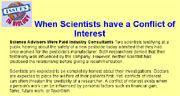
Click Here for a copy of page 23 of the Dragonfly Book, where
this issues is discussed.
Click
Here to see a full-size scan of
page xxx
Web
Resources on Conflicts in scientific Research:
Center
for Science in the Public Interest
A non-profit group that seeks to advance science to serve what
it regards as the public interest. It has a web page on the issue
of integrity in science.
Integrity
in Scientific Research
A book (readable on-line) from the National Academy of Sciences
on maintaining honesty and integrity in the conduct of scientific
research.
The
Office of Research Integrity
An important Government Office organized as a watchdog over the
donduct of scientific research. The web site features accounts
of activities of the office, some of its conferences and programs,
and a list of publications on the subject.
Ethics
in Science
An excellent web site at Virginia Tech University: "The links
and information given in this website serve as a very thorough
history and evolution of ethics in science. Many of the topics
deal specifically with research ethics, on being a scientist,
the norms of science, and the standards that are associated with
the field. There are also links to a list of essays pertaining
to various issues in science ethics."
Misconduct
in Science
An essay by Vincent Hamner that explores the types of scientific
misconduct and examines a few contemporary examples. The author
asks "Do scientists really need a professional code of ethics?"
|
Click to Return to the Dragonfly Home Page |
|
|
When
Scientists Have a Conflict of Interest
|
|
|
Use the pull-down menu at the right to jump to any of the "Issues" or "Technology & Society" Features in the Dragonfly Book: |
| INSERT
Pag
Click Here to see a full-size scan of page xxx |
|

(A web site developed by Ken Miller and Joe Levine to provide scientific and education support for teachers and students using our textbooks)