
Week
of Nov. 23, 2002; Vol. 162, No. 21
Three
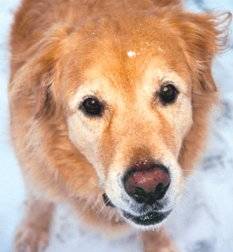
Dog Eves: Canine diaspora from East Asia to Americas
Susan
Milius
Two
genetic studies have just rewritten the history of humanity's best friend. The
new version has moved the origins of the domestic dog from the Middle East to
East Asia and argues that the first people to venture into the Americas brought
their dogs with them.
Analysis
of 654 dogs from around the world suggests that their earliest female ancestors
originated from several lineages of wolves primarily in one region, says Peter
Savolainen of the Royal Institute of Technology in Stockholm. The patterns of
genetic diversity point to East Asia as the likeliest place for the canine
Eden, Savolainen and his colleagues argue in the Nov. 22 Science.
"This
has been the search for the dog Eve," says Savolainen.
The
same issue of Science also reports on extraction of bits of DNA from New
World≠dog remains predating European influence. This DNA shows that early New
Worlders did not domesticate dogs anew, say Jennifer Leonard of the Smithsonian
Institution in Washington, D.C., and her colleagues.
"The
first Americans came across the Bering land bridge with their dogs, and this
was something we couldn't prove before," says coauthor Robert K. Wayne of
the University of California, Los Angeles.
Dogs
were probably the first domesticated animals (SN: 6/28/97, p. 400:
http://www.sciencenews.org/sn_arc97/6_28_97/bob1.htm) and have unusual
sensitivity to signals from people (see "Dog Sense," in this week's
issue: http://www.sciencenews.org/20021123/fob4.asp).
Savolainen
started studying dog genetics to help crime-scene investigators analyze hairs.
"I've been to a lot of dog shows here, snatching hairs from the
dogs," he says.
As
he assembled a large collection of dog hairs and attached cells, he began to
wonder whether he could expand it and find the cradle of the domestic dog.
He
and his international partners focused on stretches of DNA from the cells'
mitochondria, or powerhouses, which pass from mother to pup. Based on
similarities in that genetic material, 95 percent of the dogs that the
researchers had sampled come from just three lineages that seem to have arisen
in East Asia, Savolainen and his colleagues say.
To
study New World dogs, Leonard and her colleagues worked with DNA from remains
up to 1,400 years old. Thirty-seven came from archaeological sites in Peru,
Bolivia, and Mexico, and 11, from modern gold mines in the Alaskan permafrost.
When
the researchers constructed a family tree that includes modern dogs and wolves,
they found that the ancient New World dogs were much closer to Old World dogs
than to New World wolves. Also, the ancient New World lineages seem to have
disappeared from modern breeds.
The
two new studies agree with suggestions from older work: Dogs were domesticated
in the Old World, and the earliest migrants brought them to the New World,
comments geneticist David Hillis of the University of Texas at Austin. He is
convinced by the new data that the major lineages of dogs originated in East
Asia, but he sees evidence in the Savolainen study that some rarer lineages
evolved elsewhere.
****************
If
you have a comment on this article that you would like considered for
publication in Science News, please send it to editors@sciencenews.org.
To
subscribe to Science News (print), go to https://www.kable.com/pub/scnw/subServices.asp.
To
sign up for the free weekly e-LETTER from Science News, go to http://www.sciencenews.org/subscribe_form.asp.
References
and Sources
References:
Leonard,
J.A., et al. 2002. Ancient DNA evidence for Old World origin of New World
dogs. Science 298(Nov. 22):1613-1616. Abstract available at
http://www.sciencemag.org/cgi/content/abstract/298/5598/1613.
Savolainen,
P., et al. 2002. Genetic evidence for an East Asian origin of domestic
dogs. Science 298(Nov. 22):1610-1613. Abstract available at
http://www.sciencemag.org/cgi/content/abstract/298/5598/1610.
Further
Readings:
Hare,
B., et al. 2002. The domestication of social cognition in dogs. Science 298(Nov. 22):1634-1636.
Abstract available at
http://www.sciencemag.org/cgi/content/short/298/5598/1634.
Marzuola,
C. 2002. Dog sense: Domestication gave canines innate insight into human
gestures. Science News 162(Nov. 23):324. Available at
http://www.sciencenews.org/20021123/fob4.asp.
Mlot,
C. 1997. Stalking the ancient dog. Science News 151(June 28):400-401.
Available at http://www.sciencenews.org/sn_arc97/6_28_97/bob1.htm.
Pennisi,
E. 2002. A shaggy dog history. Science 298(Nov. 22):1540-1542. Summary
available at http://www.sciencemag.org/cgi/content/summary/298/5598/1540.
Sources:
David
M. Hillis
The
University of Texas at Austin
Integrative
Biology
1
University Station, C0930
Austin,
TX 78712-0253
Jennifer
A. Leonard
Department
of Organismic Biology, Ecology, and Evolution
University
of California, Los Angeles
Los
Angeles, CA 90095
Peter
Savolainen
Department
of Biotechnology
Royal
Institute of Technology
10691
Stockholm
Sweden
Robert
K. Wayne
Department
of Organismic Biology, Ecology, and Evolution
University
of California, Los Angeles
Los
Angeles, CA 90095
http://www.sciencenews.org/20021123/fob3.asp
From
Science News, Vol. 162, No. 21, Nov. 23, 2002, p. 324.
Copyright
(c) 2002 Science Service. All rights reserved.